BRIDOL is the British Sundial Society's Register of Fixed and Mass Dials, which gives detail and photographs of about 8000 fixed sundials and 3000 mass dials in the UK.
Some of these are in private gardens, but the majority are publicly available.
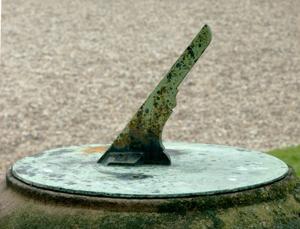
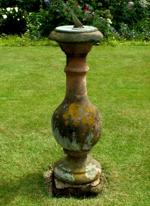
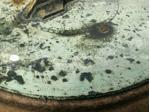
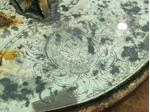
At S side motto ’Carpe Diem’, read from N, arranged either side of scroll and shield work - possibly a prancing horse. Central ’wheel-type’ EoT table, anticlockwise, with (unusually) ’Sun Slow’, ’Sun Fast’. The table appears to agree with the Gregorian calendar, and the dial may be one of the earliest to be made with an EOT display after the calendar change in England of 1752. Approximately 29 cities marked radially (from gnomon root) as ’XII City name’ to show times there at noon. Aligned Roman hour numerals V - XII - IIII - VII read from outside, with noon gap. (4am and 8pm omitted, probably to allow room for the extensive motto and shield work segment.) Shows hours and half hours (with inward lozenge ended lines). Does not mark quarters or lesser fractions except on periphery where 1, 5 and 10 mins are marked using Arabic numerals for 10s. Simple sandstone baluster type pedestal with circular capital and plinth, 1250 high. Said to have been used to regulate the tower clock in the northernmost gatehouse tower. Probable date 1750 to 1770. The place is pronounced Maxstok - its mediaeval name. Inscriptions are hard to read, but the place name Pebworth appears, as does the name Wilks.
Ref: Biographical Index of British Sundial Makers, Jill Wilson.