BRIDOL is the British Sundial Society's Register of Fixed and Mass Dials, which gives detail and photographs of about 8000 fixed sundials and 3000 mass dials in the UK.
Some of these are in private gardens, but the majority are publicly available.
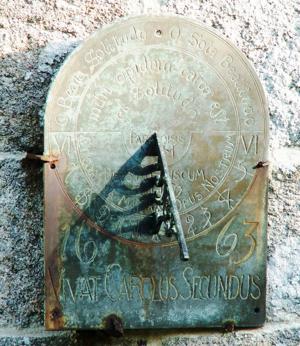
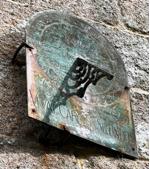
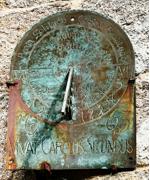
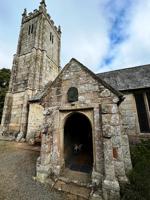
Sundials are not always what they seem and we should ignore the date 1663 and the inscription "Vivat Carolus Secundus"on this bronze one. A rather similar dial on Ringmore Towers in Shaldon has the date 1635 and the inscription "Vivat Carolus Primus". Why ’primus’?, asked Mrs Crowley when there had not yet been a second Charles. To solve the mystery of these dials you have to go to Priestgate in Peterborough where a genuinely old (1663) stone dial on the back of a restaurant gives the show away. It is clearly the original from which these 19th century dials were copied. Several more copies have been recorded in recent years. To return to the Throwleigh dial, Mrs Crowley in her South Devon Sundials paper states that it was bought from a junk shop in Exeter in 1910 and later erected in its present position above the south porch, in memory of Robert Fitzgerald Penrose who died in August 1914. A small plaque to Penrose remains below the dial. Above the date and "Vivat Carolus" inscription is a circular dial which shows the hours VI - VI though the intervening hours are in Arabic numerals with a cross to represent noon. Hour lines transfix the numerals but are not continued inwards, neither are there any subdivions. Around the top of the circle is a motto, "O Beata Solitudo O Sola Beatitudo mihi Opidum (sic) Carcer est et Solitudo Paradisus". (O blessed solitude, O solitary blessedness. The town is a prison to me and solitude is paradise). This is an extract from a Latin poem ’Solitudo’ (1566) by Cornelius Muys (Bishop Cornelis Muis 1503 - 1572) a Dutch priest and poet. The initials WH below that appear on the Peterborough dial and are those of William Hake, a Dutchman who came to England after the Restoration Another motto appears below and reads, "Deus nobiscum et corona manuum opus nostrum" (God be with us and crown tjhe work of our hands). The dial is stringly canted out on the left hand side; the gnomon has a decorative supporter.