BRIDOL is the British Sundial Society's Register of Fixed and Mass Dials, which gives detail and photographs of about 8000 fixed sundials and 3000 mass dials in the UK.
Some of these are in private gardens, but the majority are publicly available.
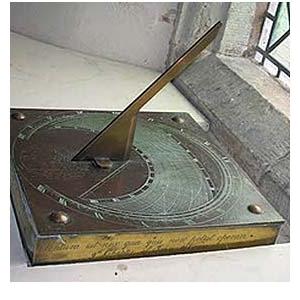
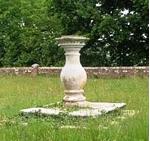
This fine double horizontal dial was once in the churchyard but is now secured inside on a deep stone windowsill in the north aisle. The fine stone pedestal on its stepped plinth still stands in the churchyard.
This is at least the third gnomon since the dial was made. About 2010 a replacement, probably attached many years ago, was vandalised. A new, correctly constructed, gnomon was made and installed. On the south side of the gnomon is the usual sloping style and on the north a shorter vertical style.
There are two scales, depending on which style used. In each case the aligned Roman hour numerals, which run from IIII through XII to VIII, are designed to be read from inside the dial.
On the large circular chapter ring the half hours are marked with fleurs-de-lys and quarters by ticks. There may be finer divisions. The time is shown on this scale by the shadow of the sloping style in the usual way.
The stereographic grid is marked to 5 minutes of time and to individual degrees of declination. This is a sophisticated instrument that can be used to find the time as well as the bearing (azimuth) of the sun, its altitude, the date and several other astronomical details. In this connection there is a diagonal alidade scale (0 to 90 degrees) in the south east quadrant which, with the aid of dividers, is used to calculate the sun’s altitude.
There is an Heraldic crest in the south section but the details are no longer clear.
To the north of the gnomon base the latitude is given. Above the grid is ’John Mark London Fecit 1678’.
There are inscriptions on narrow vertical panels around the base of the dial:
South side: ’This dial was presented to the parish . . . Nov 1815 by Maurice George Bissett Esq.…’;
East side: ’Ventura est nox qua quis non potest operari 9th Chap. John 4th verse’;
North side: ’The night cometh when no man can work’ (a translation of the Latin inscription into the words of the King James Bible);
West side a Greek version of the same quotation.