BRIDOL is the British Sundial Society's Register of Fixed and Mass Dials, which gives detail and photographs of about 8000 fixed sundials and 3000 mass dials in the UK.
Some of these are in private gardens, but the majority are publicly available.
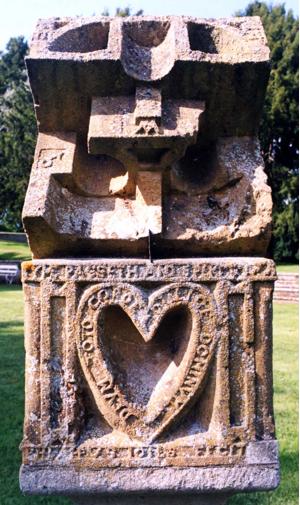
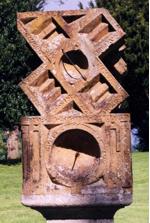
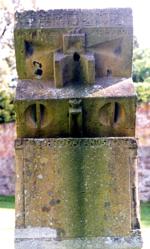
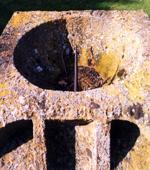
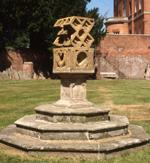
In a field beside the house is a very complicated multiple dial of sandstone. It dates from the reign of Charles II and was first set up at Monnington Court on the other side of the Wye, being brought to Moccas when the Cornewalls acquired the estate. The maker is said to have been Phillippus Jones who came from Wales. There is a small iron gnomon for a horizontal dial above the large heart-shaped scaphe on the south face; the numerous other dials are scaphe dials. There are dials on the S, W, E and N faces but no numerals are to be seen anywhere. Some declination lines can be distinguished on the E and W faces. There are several mottoes and other inscriptions which are no longer legible. ’Domus planetarum’ presumably refers to the table of planetary and zodiacal symbols while ’Instar globi stat machina mundi’ (Like a ball stands the framework of the world) is also explanatory. ’Sol est lux et gloria mundi’ (The sun is the light and glory of the world), ’Dilige Dominum Deum toto corde’ (Love the Lord God with all thy heart - Deut. vi. 5), ’Coeli enarrant gloriam Dei et operationem manum ejus annuntiat firmamentum’ (The heavens are telling the glory of God and the wonder of his work - Psalms xix .1) are further Latin mottoes. There is also a more homely English one which says ’Time passeth and speketh not. Deth cometh and warneth not. Amende to day and slack not. To morow thy self can nat’. It is thought that the dial may once have been painted white and that numerals etc may have been painted on it. The dial is mounted on a square block standing on three octagonal steps.
Compare SRN 2934 at Kinlet, Shropshire, and 2024 at Wilton, Wiltshire.
Ref: Gatty ’The Book of Sun-Dials’ 1900, p448, though she refers to the original location as Mornington Court.
Ref: Daniel ’The Sundial Page’ 2015