- Home
- /
- Notable Sundials
- /
- Refurbishment of a Pair...
Refurbishment of a Pair of Equatorial Dials
Andrew Hodgson
Entered into the 2025 Design Awards
When I first became interested in sundials, around thirty years ago (and joined the BSS), I was particularly enthused by the way they can help visualise the earth turning implacably underneath the sun. I conceived the idea (novel to me, but I'm sure far from unique) of a glass equatorial dial, with a north polar projection of the earth's continents drawn on it. This would impress on the viewer, from the direction of the shadow of the polar gnomon, that, for example, at 10 in the morning in the UK, it's 'overhead' Moscow, while at 5pm, it's noon in New York. And at noon in the UK, the sun is overhead London, throughout the year.
I wanted the land masses to be ground glass, so that you could see the gnomon's shadow on it from whichever side you looked, i.e. visible from above during the winter as well as the summer.
This was before commercially available computer-controlled laser engraving, so having laid out the artwork, the first glass disk was hand-engraved, which took the craftsman considerably longer than they had quoted for, and they declined to undertake the second, so I had that one painted instead.
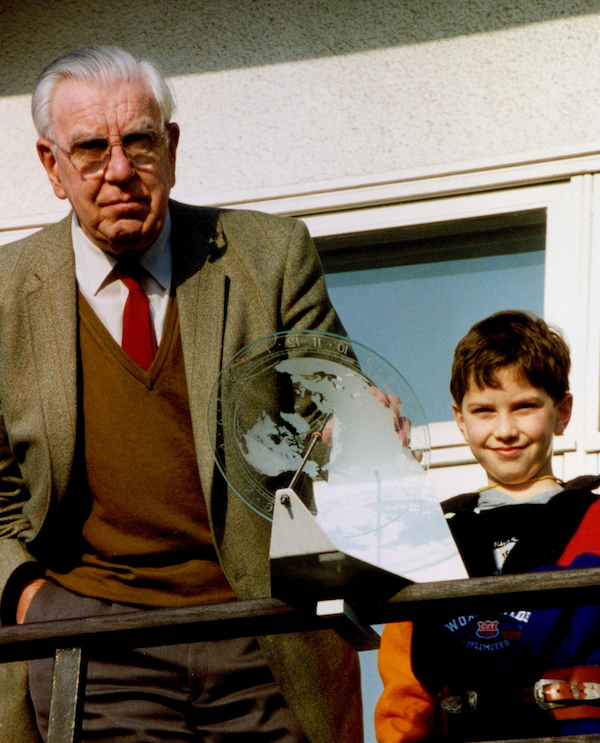


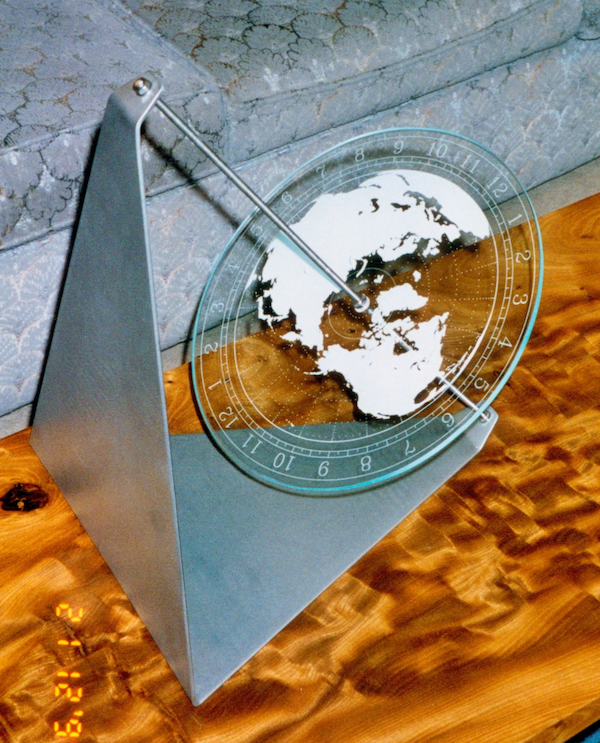
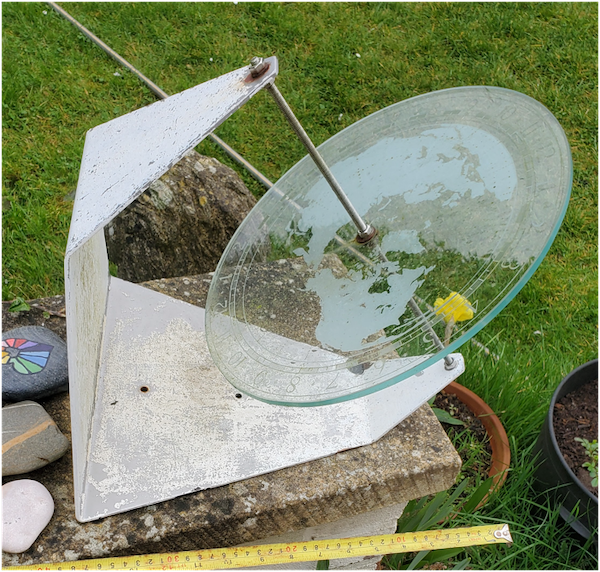
Fig 1 shows my father sternly contemplating cosmology with my son (now 41) shortly after 2pm on 23 Dec 1994, very near the winter solstice. These dials work best at the solstices. My father had painted the stainless steel white, to better view the shadows of the gnomon and dial furniture, which actually show up better on this screen than the gnomon's shadow directly on the ground glass. Fig 2 shows the second unit, the painted dial one, which went into the care of my friend whose factory had fabricated the bent stainless steel.
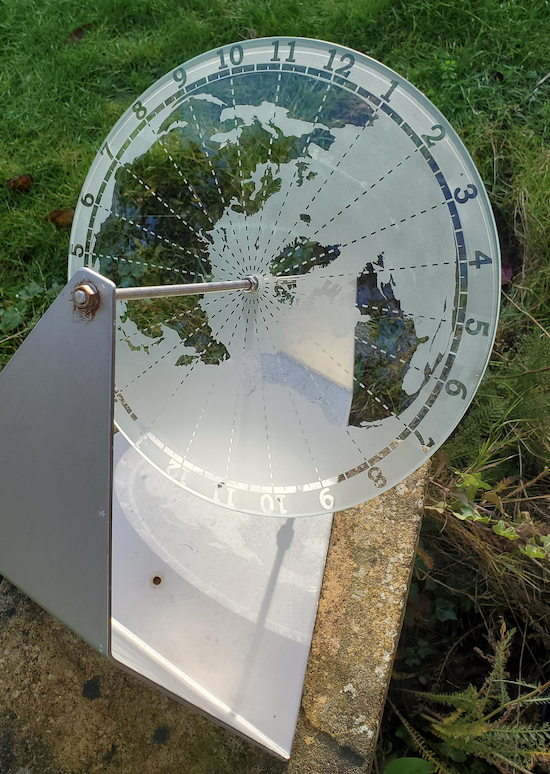
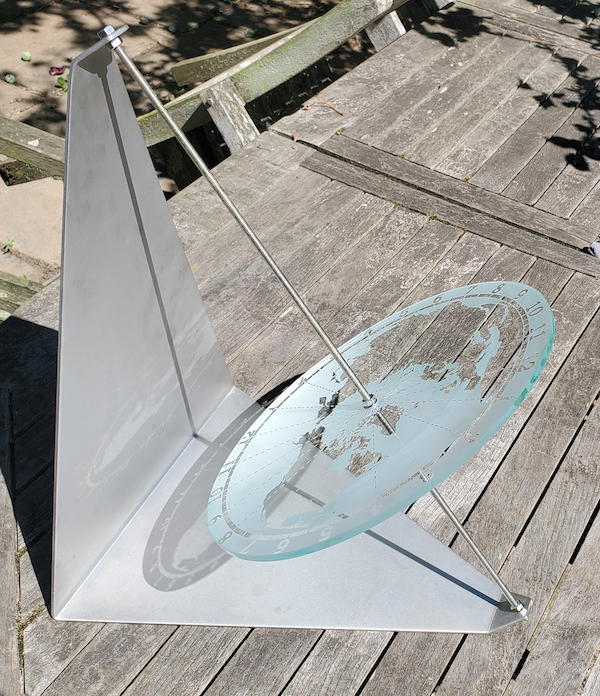
So, thirty years later, I finally found time to do something about the white paint on my father's dial (now in my garden) which was looking very sorry for itself (Fig 3), action brought on by finding that the paint on my friend's dial was completely gone (Fig 4).
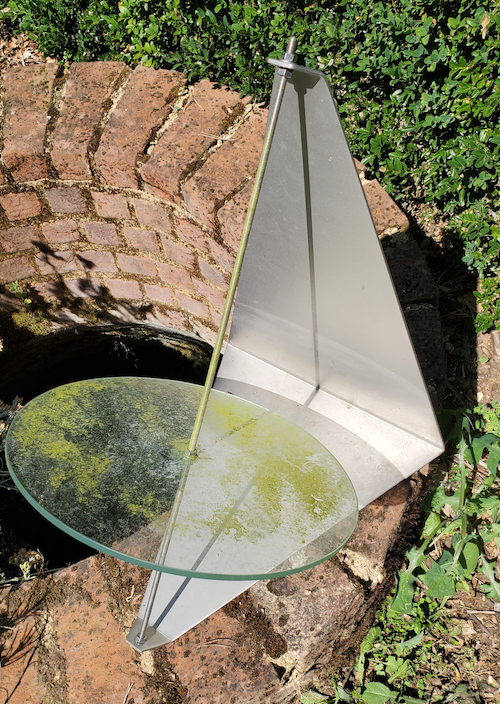
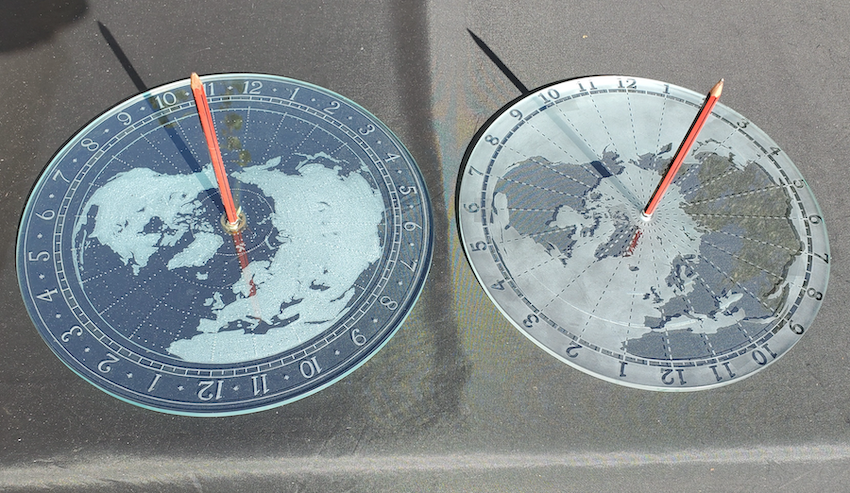
I decided they both needed restoration. I had in the meantime occasionally thought that it would have been better to have had the oceans, rather than the land masses, as the ground glass screen for the gnomon's shadow, to better exploit the fact that during most of the hours of daylight in the UK, the gnomon's shadow falls mainly on the Pacific Ocean, leaving no trace on the Mark 1 design. Finding someone to cut, drill and sandblast a pair of new glass disks was much less troublesome in 2025 than in 1994. Fig 5 compares the Mark 1 and Mark 2 disks. There is still no Equation of Time indication, as with such a wide gnomon, and imprecise hour scale, the focus here is on understanding the sun's position over the earth, rather than giving precise clock time. I do regret not engraving a motto: "And yet it moves", perhaps, or "Turn, Turn, Turn".
Figs 6 and 7 show the restored dials in operation, on 14 Dec 2025 and 8 Aug 2025 respectively. They are not much use near the equinoxes!