- Home
- /
- All About Sundials
- /
- How Sundials Work
How Sundials Work
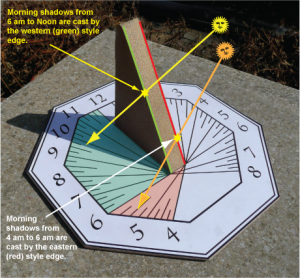
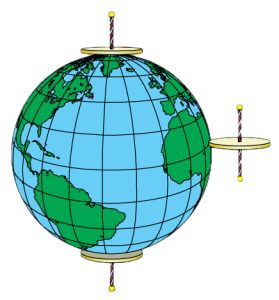
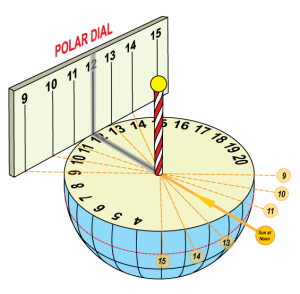
This set of pages explains, with diagrams, how a sundial works. It begins with the simplest (equatorial) dial where the shadow of a stick (the gnomon) falls on hour lines every 15 degrees apart, and then moves on to show how horizontal, vertical and polar dials are all derived from this basic type. You'll see why the gnomon needs to be inclined so that it is parallel to the earth's axis, and why the angles between the hour lines change for different latitudes. There is also an explanation of why we need to do some calculations to adjust the time shown by the sundial to convert it to clock time, and some important pointers for designing your own dials.
Devised and created for the British Sundial Society by Tony Moss BSc DLC "The Lindisfarne Presse"
Part 3
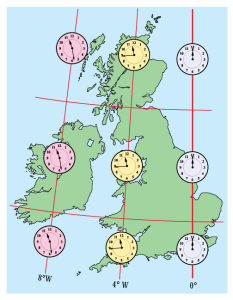
The differences between 'Clock Time' and 'Sun Time'
The reasons why you have to make adjustments to convert the time shown by the sundial into that shown by a clock.